
sg-censored

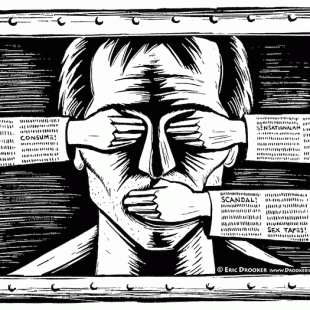
In an effort to reduce online piracy in the music and movie industries (among others), Congress and the Senate are proposing to pass two initiatives called Protect IP Act (PIPA) and the Stop Online Piracy Act (SOPA). As with any law facing our nation, these two are very complex and without a full understanding of what their intended purposes are, it can be difficult to decide how you feel. For detailed information, you should check out the official documents at the Library of Congress website: SOPA, PIPA

Continue reading “Internet Site Blackout To Protest Web Censorship in America” »

On June 28th, California governor Jerry Brown signed into law a nexus tax law (ABX 1-28) aimed at online retailers doing business in California. Almost overnight, this new law shut down countless affiliate marketers who work from home selling products from online retailers such as Amazon.com. The law’s intention was to quell the complaints from small businesses that operated traditional “brick-and-mortar” storefronts and couldn’t compete with the low prices of their online equivelents. Adding to this the fact that online retailers could run their operations in states that charge lower taxes for business, retailers like Amazon could sell goods to California residents at lower prices than anyone else.

For as long as California has been collecting taxes on businesses, the law stated that any business operating within the state that had a physical presence there would be subjected to state taxes. When online retail took off, companies were able to skate around this law by simply not have a physical presence in the state. The new law was to close that loophole and essentially define California-based affiliates as the “physical presence”. While this may have been a huge sigh of relief for local small businesses, it dealt a heavy blow to the thousands of affiliates who depend on commission sales for a large portion of their income.

Of course, Amazon was opposing this law from the start and over time has contributed over $2 million to have it repealed. It appears that this day has finally come. Now that Governor Brown has signed the repeal, here is how the process will work:

  • The California affiliate nexus provisions of ABX 1-28 enacted on June 28 are repealed and no longer of any effect, and also will not be enforced with respect to the period from June 28 through the effective date of AB 155 (i.e., the date Governor Brown signed the bill);
  • If no federal legislation is adopted over-ruling Quill before July 31, 2012, then the California affiliate nexus provisions (as re-stated in AB 155, with one important change, noted below) will become law on September 15, 2012;
  • If federal legislation overturning Quill is adopted by July 31, 2012, and California does not implement the requirements of such a federal law by September 14, 2012, then the California affiliate nexus provisions (again, as restated in AB 155, with the change noted below) take effect January 1, 2013;
  • If federal legislation over-turning Quill is adopted by July 31, 2012, and California implements the requirements of such a federal law by September 14, 2012, then the affiliate nexus provisions of AB 155 will NOT take effect.

My two cents

As a former and now current Amazon affiliate marketer, I am all for this repeal and hope it remains permanent. After all, Amazon has been fighting this battle for some time now when other states have enacted similar laws and received no major positive results. In fact, those states reported more bad than good. California’s attempt at finding new revenue streams has failed in this case and as a marketer myself and online shopper, I applaud their efforts and hope that California will never look at this law again.

Remember back in March of 2010 when that mysterious prototype iPhone was found in a bar that fueled the speculation of what the new iPhone 4 was going to look like? For those that don’t remember, an Apple employee charged with the task of testing a fully functional iPhone in the ‘real world’ spent his birthday at a local bar, ended up drinking too much and left the prototype phone at the bar only to be found by another patron. It was this guy and his friend that pitched the sale to Gizmodo.com’s Jason Chen.

Shortly after Jason took possession of the device, he blasted out blog posts including pictures and videos showing off the new device and only speculating what could possibly be inside. It was then that one of the largest tech exclusives took off. It became world news for 2 reasons. 1. Everyone was waiting to hear about any little detail they could find regarding a new iPhone and 2. Apple NEVER gives sneak peaks or media previews. They make their announcements to the world while everyone is watching.

Originally after the news broke, everyone was up in arms about who could have done this, was the device stolen, was Jason Chen’s possession of it illegal, etc. After a year of investigations, Jason Chen will not have any charges filed against him. Apparently, as a journalist, he is covered by the shield laws that basically protects a journalist’s 1st amendment rights as a reporter.

At the time authorities had seized Jason’s computers and notes related to the unfolding event, although it’s widely believed that this seizure was illegal because they ended up taking unpublished notes from a reporter—another gray area of the shield law.

Prosecutors claim that although they potentially have a case with charging Jason Chen, they are opting not to pursue due to the many gray areas that could upset a final verdict. The two individuals responsible for finding and selling the device to Gizmodo are not so lucky. Brian Hogan and Sage Wallower are both getting slapped with misdemeanor charges. Hogan was charged with one count of misappropriation of lost property; Wallower with misappropriation of lost property, and possession of stolen property. Each faces a maximum of a year in county jail, plus fines and probation.

My two cents

This truly is a gray area because I believe that all parties knew what they had. Even without it being an iPhone prototype, they all had to have known they were doing business with stolen property, but as the prosecutors knew, it might be impossible to prove that Jason Chen knew that. Adding to that, the “illegal” search and seizure and you no longer have an open and shut case.

Either way, none of this really matters anymore. Apple got the phone back and it appeared that none of the leaks damaged any sales. In fact, that kind of press might have actually helped sales.

Amidst all the debt ceiling confusion surrounding today’s financial drama, it’s amazing to find out that a large corporation such as Apple actually has more cash on-hand than the whole United States government!

Ok, maybe it’s not such a surprise after all given that our government spends more than they bring in and when they need more cash, they practically just print it. I won’t go into all the details here, but to summarise the situation very quickly, our country has a limit to how much debt we can have. That limit is currently set at $14.4 trillion dollars. Let’s see that number in all its glory: $14,400,000,000,000 That’s a lot of money. Anyway, it appears that we’re nearing that limit and fast, so the debate is redhot: do we increase the limit to allow us to borrow more money or do we cut spending to reduce the amount borrowed?

As a result of trying to figure out how to solve this problem, politicians have let our national coffers dip to a dangerously low amount. The best analogy for this chaos is if our government was using a single credit card for all of its spending, they are reaching the credit limit. To offset this, they have practically wiped out their bank account and are now waiting to see if their credit limit will be increased. That leaves the whole United States with an unmanageable debt and only $73,768,000,000 ($73.768 billion) in the bank.

Apple Inc. currently has $76,156,000,000 ($76.156 billion). The maker of fine products such as OS X, iPhone, iPad, iPod and Macbook is theoretically richer than the whole country. How does that sit with you?!

While this $2.388 billion difference might seem like a small number, it’s really not when you consider that the country’s income is comprised of every tax-paying individual living in this country, every product exported out to the world and a slew of other things like investments, bonds, etc. Since it’s clear that the government’s income is far greater than Apple’s, the problem must lie with the spending—wow, did I just solve a major national crisis with just one sentence?! Someone please send this link to Obama and Congress. :)

On a sidenote, Apple is now poised to become the largest corporation on the planet (in terms of profit) after reporting an estimate $5.5 billion in iPhone sales in this year’s third quarter. Let’s see if someone can finally take down oil-giant ExxonMobil!

If you were wondering what it would be like if Apple gave all of its money to the government, you could expect the cash to run out in about a week because according to Fortune magazine, the U.S. government spends roughly $10 billion a day! Maybe the government should start selling iPods to recoup some of their losses. I guess it wouldn’t matter because I’m sure they’d find something frivolous to spend it on.